The Game
The Any 7 Bet is a form of craps betting which pays when one of the six dice combinations which total seven is rolled. So, when a player rolls the following combinations of 1-6, 2-5, 3-4, they win their bet. However, when any other combination is rolled they lose. This crossword clue Seven and eleven, in craps was discovered last seen in the June 14 2020 at the LA Times Crossword. The crossword clue possible answer is available in 8 letters. This answers first letter of which starts with N and can be found at the end of S. We think NATURALS is the possible answer on this clue. Playing Craps Online Vs. Land-Based Casinos 7 Advantages To Playing Online. Playing craps on the internet comes with notable benefits. Especially as you are learning the game and how it works. First, you don’t have to travel to a traditional casino. That alone is a big advantage. Nor do you have to pay for a hotel room or food.
Craps is a dice game where two dice are rolled and the sum of the dice determines the outcome.
- If the sum is a 7 or 11, you win and the game is over.
- If the sum is a 2, 3, or 12, you lose and the game is over.
- If you roll a 4, 5, 6, 8, 9, or 10, that value becomes your 'point' and you continue to roll until you re-roll your point or a 7. If you roll your point, you win; if you roll a 7, you lose.
Video: Use Real Player to listen to the instructions and watch several games to make sure you understand the game. (56k - DSL/Cable)
Some of the probabilities are easy to find. The fundamental counting principle tells us there are 6*6=36 ways to roll two dice, all of them equally likely if the dice are fair. There is only one way to roll a sum of 2 (snake eyes or a 1 on both dice), so the probability of getting a sum of 2 is 1/36. There are 4 ways to get a five (1-4, 2-3, 3-2, 4-1) so the probability of getting a five is 4/36. The probabilities of obtaining any of the first roll sums can be found fairly easily and are shown in the table below.
Probabilities of Sum on First Roll| Sum | 2 | 3 | 4 | 5 | 6 | 7 | 8 | 9 | 10 | 11 | 12 |
| Probability | 1/36 | 2/36 | 3/36 | 4/36 | 5/36 | 6/36 | 5/36 | 4/36 | 3/36 | 2/36 | 1/36 |
We can find the probability of winning, losing, or obtaining a point on the first roll of the game by adding up the probabilities for the sums that go with winning, losing, or getting a point. For example, since a 7 or an 11 is a winner on the first roll and their probabilities are 6/36 and 2/36, the probability of winning on the first roll is 6/36+2/36=8/36.
Probabilities of Winning, Losing, or Getting a Point on First Roll
| Outcome | Win | Lose | Point |
| Probability | 8/36 | 4/36 | 24/36 |
The Point
The main problem with game of craps is that it can theoretically go on forever when a point is obtained on the first roll. Now, in actual practice, it doesn't. Eventually, you are going to either re-roll that point and win or roll a 7 and lose.
But, becasue you could theoretically go on forever, finding the probabilities involve an infinite geometric series. As an example, consider the case when the point is a 9 that is shown in the tree diagram to the right. Once you roll a 9, there is a 4/36=1/9 chance of rolling it again on any roll and a 6/36=1/6 chance of rolling a 7 and losing. However, there is a 13/18 chance that you will roll neither and the game will continue for another round.
There is a 1/9 chance of winning on the second roll (the first after the point), a 13/18*1/9=13/162 chance of winning on the third roll, a 13/18*13/18*1/9=169/2916 chance of winning on the fourth roll. But it doesn't stop there, it keeps going, and going, and going. Then you have to add all those probabilities up and that involves an infinite geometric series. That might not be difficult for you, but since the prerequisite for the applied statistics course is just intermediate algebra, most of the students have never seen an infinite geometric series.
So, there has to be another way.

The Simulation
This is a game that is most fun when it is simulated using actual dice. Sure, it would be possible and quicker to simulate it using a computer, but it wouldn't be nearly as fun.
Here's how the simulation works. Roll a pair of dice and record the sum in the table where it says 'Sum on first roll'. We are then going to record the result of the first roll as 'Win', 'Lose', or 'Point' in the table where it says 'Result of first roll'. If the sum is a 2, 3, 7, 11, or 12, go ahead and copy the first roll results into the overall results column and move on to the next game. If you have rolled a point, continue to roll the die until you roll either that point or a 7, but do not record the value of each of those rolls. Once you have rolled your point or a 7, then record either 'Win' or 'Lose' in the table for the overall results. You may wish to abbreviate the results as 'W', 'L', or 'P'.
| Game | Sum on first roll | Result of first roll | Overall Result |
|---|---|---|---|
| 1 | |||
| 2 | |||
| 3 | |||
| 4 | |||
| 5 |
The Analysis
After you have played several games (I recommend 36 since there are 36 different outcomes possible and it makes the probabilities nicer), it's time to sit back and look at what you have gathered.
First Roll Probabilities
Go through and count how many times each sum appeared as the first roll of the dice. Record it in the table below as a fraction over the total number of rolls and compare it to the theoretical probabilities we found earlier. Kajot casino cz.
| Sum | 2 | 3 | 4 | 5 | 6 | 7 | 8 | 9 | 10 | 11 | 12 |
| Observed | |||||||||||
| Theoretical | 1/36 | 2/36 | 3/36 | 4/36 | 5/36 | 6/36 | 5/36 | 4/36 | 3/36 | 2/36 | 1/36 |
Are the observed probabilities close to the theoretical probabilities? They should get closer as you simulate more crap games (law of large numbers).
First Roll Outcomes
Now add the number of times you got a win, lose, or point on the first roll of the dice and write that as a fraction. If you played the game right, this can also be found by adding the probabilities of getting a win (7 or 11), lose (2, 3, or 12), or point (all else) together.
Record them in the table below and compare them with the theoretical probabilities found by adding the theoretical probabilities as mentioned in the last paragraph or that we found earlier in this document.
| Outcome | Win | Lose | Point |
| Observed | |||
| Theoretical | 8/36 | 4/36 | 24/36 |
Final Results
7 And 11 In Craps Game
You're probably thinking to yourself that this has been pointless. So far, we haven't found anything that we couldn't find through simple probabilities and it was much quicker and more accurate (exact instead of an approximation).
What we're really interested in finding is the final outcomes of the game; that is, the probabilities of winning or losing the whole game. Count how many times you won and lost for the overall results and write that as a fraction over the total.
| Outcome | Win | Lose |
| Observed | ||
| Theoretical | 244/495 | 251/495 |
Big easy free slot game online. Did your results come out close to the theoretical results (found using infinite geometric series or absorbing markov chains)? You should have lost a few more games than you won. Well, after all, the casinos want to make money, don't they?
Type of Simulation
This is a simulation used to find probabilities. In this kind of simulation, you conduct an experiment and ultimately find the number of successes divided by the number of trials to find the relative frequency or the empirical probability. Success is defined as whatever you're trying to find the probability of. So, if you're looking for the probability of rolling a 6, then it is the number of 6's over the total number of rolls. If you're trying to find the probability of losing the game, then it is the number of losses divided by the total number of games.
Return to Simulation Page
On This Page
Introduction
Crapless Craps is a craps variant that treats the 2, 3, 11, and 12 as point numbers (like 4,5,6,8,9, and 10). I believe the game started at the Stratosphere, or maybe even its predecessor, the Vegas World decades ago. It is certainly one of the earliest novelty games and one of the most successful. Today, it is very popular in the casinos of Detroit, but can still be found at the Stratosphere.
Rules
The rules of Crapsless Craps are the same as conventional craps, which I assume the reader is familiar with, except all totals except seven establish a point. Thus, on the come out roll, the player either wins (with a seven) or a point is established. No more crapping out.
If you're not familiar with the rules of craps, following are the rules for the Pass bet, the most fundamental bet in craps and Crapless Craps.
- The first roll is called the 'come out roll.'
- If the come out roll is a total of seven, then Pass bets win.
- Otherwise, whatever total was rolled, becomes the 'point.'
- The dice are rolled again.
- If the outcome of the roll in rule 4 is the 'point,' then Pass bets win and are paid even money.
- Otherwise, if the outcome of the roll in rule 4 is a seven, then Pass bets lose.
- Otherwise, on any other outcome, nothing happens and return to rule 4.
To the craps player, this may seem like a good value. No more losing on the come out roll. However the player gives up:
- Winning with a total of 11 on the come out roll.
- If a 2, 3, 11, or 12 is rolled on the come out roll, the Pass bet will likely lose, because these totals are much less likely than a total of seven.
Overall the house edge on the pass bet in crapless craps is 373/6930 = 5.382%. Compare that to that of conventional craps at 1.414%.
Odds Bet
Crapless craps does offer free odds of 6-1 on the 2 and 12, and 3-1 on the 3 and 11. The following table shows the combined house edge by combining the pass line and the odds:
Combined house edge on pass and buying odds in Crapless Craps
Place Bets
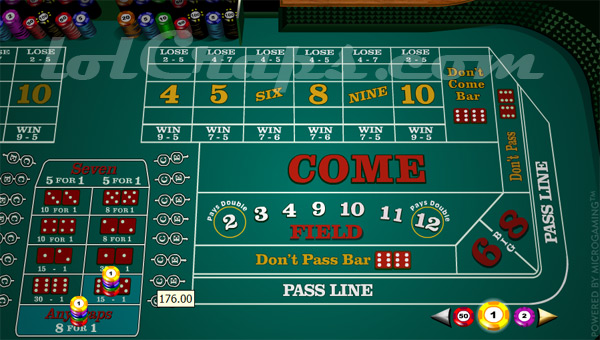
You can also make place bets on the 2, 3, 11, and 12. The 2 and 12 pay 11-2 with a house edge of 7.143%. The 3 and 11 pay 11-4 with a house edge of 6.250%. There is no don't pass bet in this game.
7 And 11 In Craps Crossword
You can also make buy bets. On points of 4, 5, 6, 8, 9, and 10 the odds are the same as regular craps. The following table shows the odds on the 2, 3, 11, and 12. One reader claims they only charge the commission on wins in Mississippi but I'll list it both ways.
Betting 6 And 8 Craps
Buy Bets in Crapless Craps
| Bet | Pays | Prob. Win | House Edge |
|---|---|---|---|
| Place 2, 12 | 11 to 2 | 14.2857% | 7.1429% |
| Place 3,11 | 11 to 4 | 25.0000% | 6.2500% |
| Buy 2, 12 (commission only on wins) | 119 to 20 | 14.2857% | 0.7143% |
| Buy 3,11 (commission only on wins) | 59 to 20 | 25.0000% | 1.2500% |
| Buy 2, 12 (commission always) | 119 to 21 | 14.2857% | 4.7619% |
| Buy 3,11 (commission always) | 59 to 21 | 25.0000% | 4.7619% |
Any Seven Craps System
Written by:Michael Shackleford